Lumosity: Brain Training Games from FunForAll with fun, engaging and rewarding puzzles and brain challenges.
Lumosity: Brain Training Games by funforall:
Adaptive mini-game memory, speed, attention and problem solving, one of the most popular structured cognitive training apps.
Lumosity: Brain Training Games
About this app Lumosity
Train your mind with Lumosity’s fun science-based brain games.
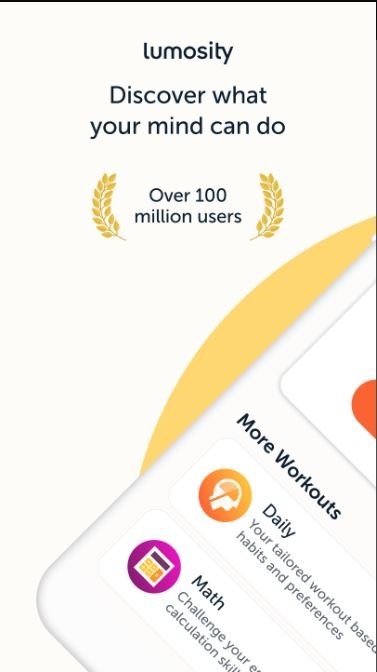
Lumosity is a top brain training application, utilized by in excess of 100 million individuals all over the world to play the reasoning games that exercise memory, attention, problem solving, and more.
WHAT’S INSIDE THE APP
Play up to 40+ Brain Games, which adjust to your level as you play!
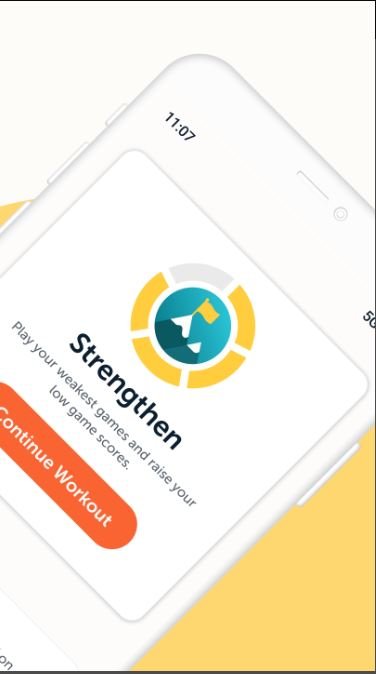
Fitness plans to help train your brain each day!
You’ll get feedback on how you’re doing.You’ll receive feedback on your performance.
Gain insight into your training and set goals
The first step to a FIT test is to get started.
You can participate in a FREE 10-minute Fit Test to establish baseline scores and gauge your performance compared with others your age.
Find a game level that suits your abilities and take part!
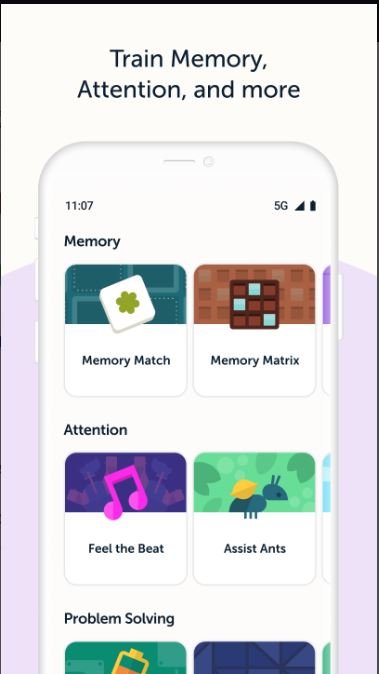
Select the skill you are looking to work on, with games for speed, memory, attention, flexibility, problem solving, math and word games.
Brain Workouts Per Day For Maximum
Create a daily routine based on exercise plans tailored to you. Have customised challenges according to training preferences and methods. Develop essential skills through targeted and chosen brain games.
DETAILED TRAINING INSIGHTS
Get the most detailed performance insights to understand your strengths and weaknesses in the game. Obtain Game Play Analysis to better understand your thought processes.
The Science behind LUMOSITY
Our team consists of scientists and designers who are working on new methods to engage the brain and further research. We take on well-known cognitive and neuropsychological tasks, or we develop brand new, experimental tasks. We then make these tasks into games and puzzles to test some of the fundamental cognitive abilities.
Additionally, we cooperate with over 40 university scientists from around the globe. We provide qualified researchers free access to Lumosity’s tools, to support new investigations in the cognitive sciences.
WHO IS LUMOSITY FOR?
For all ages to challenge their minds in fun, brain training games
•Lifelong learners who want to learn about games that engage the cognitive skills.
Anyone wanting to practice memory, speed, attention or problem-solving.
It’s easy to squeeze in a positive brain exercise with Lumosity, whether it’s during your morning coffee or right before bedtime.
Join millions using Lumosity to train their minds. Download now and develop a brain training routine.
LUMOSITY PREMIUM & TERMS
Lumosity Premium will provide you with a customizable training program to exercise, detailed information about how you’re playing and feedback to make it more accurate, faster and strategically stronger.
Lumosity Premium users pay for their subscription through Google Play, once they have been subscribed. Your subscription will automatically renew at the above price and term until it is cancelled at least 24 hours before the end of the current term.
There is a charge for renewal that will be made within 24 hours of the end of the current period. You can control your subscription and stop automatic renewal in your Google Play account settings after you buy it. The remaining amount of each term is not refundable, and a purchase at any time will cancel the free trial period.
Version
10.20.99
Updated on
Oct 7, 2026
Requires Android
8.0 and up
Downloads
10,000,000+ downloads
In-app purchases
Rs 105.00 – Rs 66,700.00 per item
Content rating
Ages 3+ Learn more
Permissions
View details
Released on
Jun 8, 2014
Offered by
Lumos Labs, Inc.
Support for compatible working devices *
Samsung SM-S908E
Version
10.20.99
Compatibility
Works on your device
Download Size
123 MB
Requires
Android 8.0 and up
Samsung SM-G998B
Version
10.20.99
Compatibility
Works on your device
Download Size
123 MB
Requires
Android 8.0 and up
Samsung SM-S908E
Version
10.20.99
Compatibility
Works on your device
Download Size
123 MB
Requires
Android 8.0 and up
Instructions for using this app on your device(s)
The compatibility information in this section indicates if this app will run on your device. You’ll only see devices that are linked to your Google Account and that have been active in the last 30 days.
Lumosity: Brain Training Games by FunForAll can be advertised as a fun place to visit for anyone that enjoys challenging games and brain teasers. These activities can make us think, see patterns, remember and solve problems while having fun!
Why Try Lumosity: Brain Training Games by FunForAll?
FunForAll’s Lumosity: Brain Training Games provides a great mix of fun and stimulation. We are not passive consumers of information on the internet, but we are active and making decisions, recalling information, looking for patterns and trying to find solutions.
With Lumosity: Brain Training Games by FunForAll, we can choose different types of challenges according to our interests. Some games can be memory based, others can be attention based, some can be speed based, some can be logic based, and some can be problem-solving based.
7 Exciting Brain Training Challenges
Brain Training Games by FunForAll offers a number of popular mental games that can be incorporated:
Memory Games – Remember objects, places, numbers or sequences.
Attention Games – Do these to challenge your attention and ability to notice important things.
Logic Puzzles – Promote logical thinking and problem-solving skills.
Relationships between elements – Pattern Games – Ask us to identify relationships between different elements.
Speed Challenges – See how quickly we can identify information and react to it.
Word Games – Integrate word knowledge, recognition, and problem-solving.
Number Challenges – Fostering mathematical thinking and pattern recognition.
The various games categories allow Lumosity: Brain Training Games by FunForAll to be played by those who want to play a game of some kind rather than just a particular type of puzzle repeatedly.
Brain Training Games for Fun and Daily Challenges
Lumosity: Brain Training Games by FunForAll can be an easy game to play when we’re looking for a quick mental workout. In the break, we can spend a few minutes solving the puzzles, or have a longer one in a longer session.
The emphasis can be on providing an enjoyable gaming experience at funforall.online, allowing the visitor to explore various types of puzzles and challenges. For those who love brain games, Lumosity: Brain Training Games by FunForAll is a new addition to the list.
Enhance the Problem-Solving Process
By playing Lumosity: Brain Training Games by FunForAll, we are reminded to take steps carefully. Instead of just picking out the initial answer that seems correct, they can analyze the available data, look for patterns, and think of other solutions.
Playing Lumosity: Brain Training Games regularly can also help to make puzzle solving more familiar. Exposing us to new game formats helps us to learn the rules, find clues, and create strategies to solve each problem.
Final Thoughts
Lumosity: Brain Training Games by FunForAll offers a fun and exciting way to learn and play while engaging the brain. These activities could give something to play for various types of players from memory and attention games to logic, number, word and pattern puzzles.
If you are seeking out entertaining challenges to explore online, funforall.online may be a convenient spot for you. Lumosity: Brain Training Games by FunForAll is a great subject for puzzle, brain game, mental exercise, and online interactive entertainment enthusiasts.
Find out what your brain can accomplish.
Learn how to control your body, think flexibly and more, in the most popular brain-training program in the world!
You don’t want to risk damage to your brain. We do, too.
Work on skills that you most need to acquire. Memory. Attention. Reasoning. Lumosity targets these cognitive skills, and more.
The scientific method, on a jaffle.
Lumosity is a compromise between tasks from the lab and makes them into games. Your scores give us feedback and detailed Cognition insights that we use to provide actionable responses for you.
Brain exercise everyday
Use a new batch of games every day to get a new challenge. Complete tracking of progress keeps your brain training program on track.
Brain Training specifically for YOU!
Lumosity acknowledges that each brain is an individual and adjusts the program to your strengths and weaknesses, no matter how young or old you are, or at the intermediate or advanced level.
Researching about the effectiveness of Lumosity
What we did
A randomized study was done by Lumos Labs at Lumosity brain training and published in a peer reviewed research journal. In it, half of the 4,715 participants who completed the study trained five days per week, for 15 minutes each day on Lumosity while the other half did online crossword puzzles as an active control.
What we found
Lumosity users also showed greater improvement than controls on our measures of Working Memory, Short-Term Memory, Processing Speed, Problem Solving, Fluid Reasoning, and overall cognitive function, after 10 weeks. The findings are beneficial, but more studies are required to assess the relationship between the enhanced assessment scores and daily activities in the participants’ life.
Next questions
There were also danger of inadvertent experimenter bias and danger of attrition bias because both groups (Lumosity and crossword) had 50% attrition.In this study there was the potential for risk of inadvertent experimenter bias and risk of attrition bias because both groups (Lumosity and crossword) experienced a 50% attrition rate. Like with any scientific study, there is a possibility of publication bias.
The games are so fun, so interesting and so different. Bit many of the options are limited because I haven’t paid for the full version and it’s really annoying. I would love to see my track of the hours I slept and my mood over but it’s limited for premium users only. I can play 3 games a day, but I would like to see how my progress is going over a period of time.
I really enjoy this app and I’m using the free version so that I can play 3 games a day or repeat the same game as many times as I like if I want to get really good at it. As in most games, practice makes perfect and overall they are good, challenging games that work the brain. It is well animated with sounds and you can opt for silence.
Absolutely fantastic app, but price is extortionate. I really don’t understand the pricing £16.49 a month or £87.99 per year!!!!!. This is a million dollar title that is developed by the best of the best, and it’s available for £60, and it’s yours for life. A more realistic price is surely a £1 subscription or a £40 for life. With these nutsack prices you’re pricing millions of users out of buying.
Lumosity brings research to life, and takes tasks from the lab. Your scores are interpreted with the goal of providing feedback and insights into your thinking that can be put to use.
Effective and legal history.
Lumos Labs reached a settlement with the Federal Trade Commission on January 5, 2016 on a claim of false advertising for their product, the settlement being $50 million, which was reduced to $2 million, with financial verification. The Commission concluded that Lumosity uses fear as a marketing tactic to market their games as a way of combating memory loss, dementia and even Alzheimer’s disease without offering any scientific evidence.
The company was told not to make any claims that its products can “[improve] performance in school, at work, or in athletics” or “[delay or protect] against age-related decline in memory or other cognitive function, including mild cognitive impairment, dementia,
or Alzheimer’s disease”, or “cognitive impairment caused by health conditions, including Turner syndrome, post-traumatic stress disorder (PTSD), attention deficit hyperactivity disorder (ADHD), traumatic brain injury (TBI), stroke, or side effects of chemotherapy”, without “competent and reliable scientific evidence.
In astronomy, luminosity is the total radiant power of an astronomical object (such as a star, galaxy, or other radiant astronomical object) emitted per unit time, which is synonymous with radiant power emitted by a light-emitting object.
Luminosity, in the SI system, is measured in joules per second (or watts). In astronomy, the luminosity of the Sun, L is often used as a unit of luminosity. Alternatively, luminosity can be expressed within the astronomical magnitude system,
with the absolute bolometric magnitude (Mbol) of an object being a logarithmic measure of the total energy emission rate of an object, and absolute magnitude being a logarithmic measure of the luminosity within some specific wavelength range or filter band.
The word brightness, by contrast, tends to be used in astronomy to describe the brightness of an object, as it appears to an observer. The apparent brightness of an object is influenced by the luminosity of the object, the distance between the object and the observer, and to any absorption of light in the path from object to observer. If the luminosity is believed to be known, the apparent brightness can also be used to determine distance: the luminosity distance.
Brain Training
Brain training, also called mental exercise or cognitive training, means doing regular activities that are designed to help maintain or improve our thinking skills. These skills can include memory, attention, problem-solving, reasoning, planning, and decision-making.
The basic idea is similar to physical exercise. Just as we exercise our bodies to stay physically fit, we can challenge our brains with different activities to keep our minds active.
Brain training can include many different activities. We can play online brain games, puzzles, video games, memory exercises, and problem-solving games. Other activities such as learning music, dancing, drawing, painting, reading, or learning a new skill can also challenge the brain. Physical exercise may also support overall brain health.
Brain Plasticity
One important idea behind brain training is brain plasticity, also known as neuroplasticity. This means that the brain can change and adapt throughout life.
Our experiences, learning, and regular activities can affect how the brain works. The brain is not completely fixed after childhood. It can continue to develop and create new connections as we learn and practice different skills.
However, scientists still debate how effective brain-training programs are. Some research suggests that certain types of training can improve performance on the activities we practice. At the same time, it is not always clear whether these improvements transfer to completely different skills or everyday activities.
Brain Training Studies and Activities
Cognitive training focuses on mental skills such as problem-solving, reasoning, attention, memory, planning, and other executive functions.
These skills are important because they are connected with learning, education, work, and many everyday activities. Researchers have studied whether regular mental exercises can help people improve these abilities.
One important concept is cognitive reserve. Cognitive reserve refers to the brain’s ability to handle different mental challenges. A person with good cognitive reserve may be better able to understand information, connect ideas, solve problems, and make reasonable decisions.
Researchers have suggested that regularly doing mentally challenging activities may help support cognitive reserve.
Brain Training for Different Groups
Scientists have studied cognitive training in different groups of people.
Some studies have focused on people with memory and thinking problems, including people with conditions that affect the brain. Researchers have also studied cognitive training for children who have attention and learning difficulties.
Older adults have received particular attention because some thinking abilities can change as we get older. These changes may include slower processing speed, changes in working memory, long-term memory, and reasoning.
However, lower performance on a particular mental test does not always mean that an older person has lost the ability. Sometimes people use different strategies when completing a task. For example, an older person may choose not to use a particular memory strategy even though they are capable of remembering the information.
Why Brain Plasticity Is Important
Brain training is based on the idea that the brain can change through learning and experience.
Research on people who develop special skills has provided evidence that experience can affect the brain. For example, studies of musicians have examined changes in areas of the brain related to music and movement.
Researchers have also studied London taxi drivers, who need to remember and navigate many streets. Their work has been used as an example of how extensive learning and experience can be connected with changes in certain areas of the brain.
These studies suggest that the brain can adapt when we repeatedly learn and practice complex skills.
Learning New Skills and the Brain
Learning a new skill can provide a challenge for the brain. Researchers have studied activities such as juggling to understand how learning affects the brain.
In one study involving older adults, participants learned to juggle. Researchers observed changes in gray matter in certain areas of the brain after the training period.
This does not mean that juggling or one particular activity will automatically improve every mental ability. Instead, it provides evidence that learning and practicing a new physical and mental skill can be associated with changes in the brain.
Does Brain Training Improve Other Skills?
One important question is whether getting better at one brain-training exercise also makes us better at completely different tasks.
Research has produced mixed results.
For example, a study that trained young and older adults on a particular executive-function task found that both groups could improve their performance on the trained task. However, broader improvements on new and different tasks were mainly observed in the younger participants.
This suggests that practice can make us better at the activity we practice, but the improvement may not always transfer to other abilities.
Scientists believe that transfer may depend on how similar the trained activity is to the new task. If two activities use similar parts of the brain or similar mental processes, improvement may be more likely to carry over.
Changes in the Brain During Cognitive Training
Research has also found that cognitive training can be connected with changes in how the brain works.
For example, some attention-training studies have reported changes in blood flow to areas of the brain involved in attention and planning, including the prefrontal cortex.
Other research involving older adults has found changes in the way different brain areas are used while completing cognitive tasks.
These findings show that mental training can be associated with changes in brain activity. However, researchers continue to study what these changes mean for everyday thinking and long-term cognitive health.
Simple Conclusion
Brain training means regularly challenging the mind through activities such as puzzles, memory games, problem-solving exercises, video games, learning, music, art, and other new skills.
The main idea behind brain training is neuroplasticity, which means that the brain can adapt and change through learning and experience.
Research suggests that practicing a particular mental activity can improve performance on that activity. However, it is still not certain that every brain-training exercise will improve all areas of intelligence or everyday thinking.
For this reason, brain training can be viewed as one useful way to keep the mind active and practice cognitive skills, especially when combined with learning, physical activity, social interaction, good sleep, and other healthy habits.